
Home / Products / DevSec Champions
Proprietary · Training platformDevSec Champions
An interactive platform for secure development practice and cyber risk awareness. Developers, engineers and technical teams learn security by doing — realistic scenarios, genuinely vulnerable code, and challenges that can be exploited rather than merely described.
Visit devsec-champions.comThe problem
Nobody remembers the training. That is the whole problem.
Most secure-development training is watched, ticked and forgotten. It uses sanitised examples, in a language the team does not write, and nothing ever verifies what actually stuck.
Six weeks later the same vulnerability ships. Not because the developer is careless — because they were never put in front of the real thing.
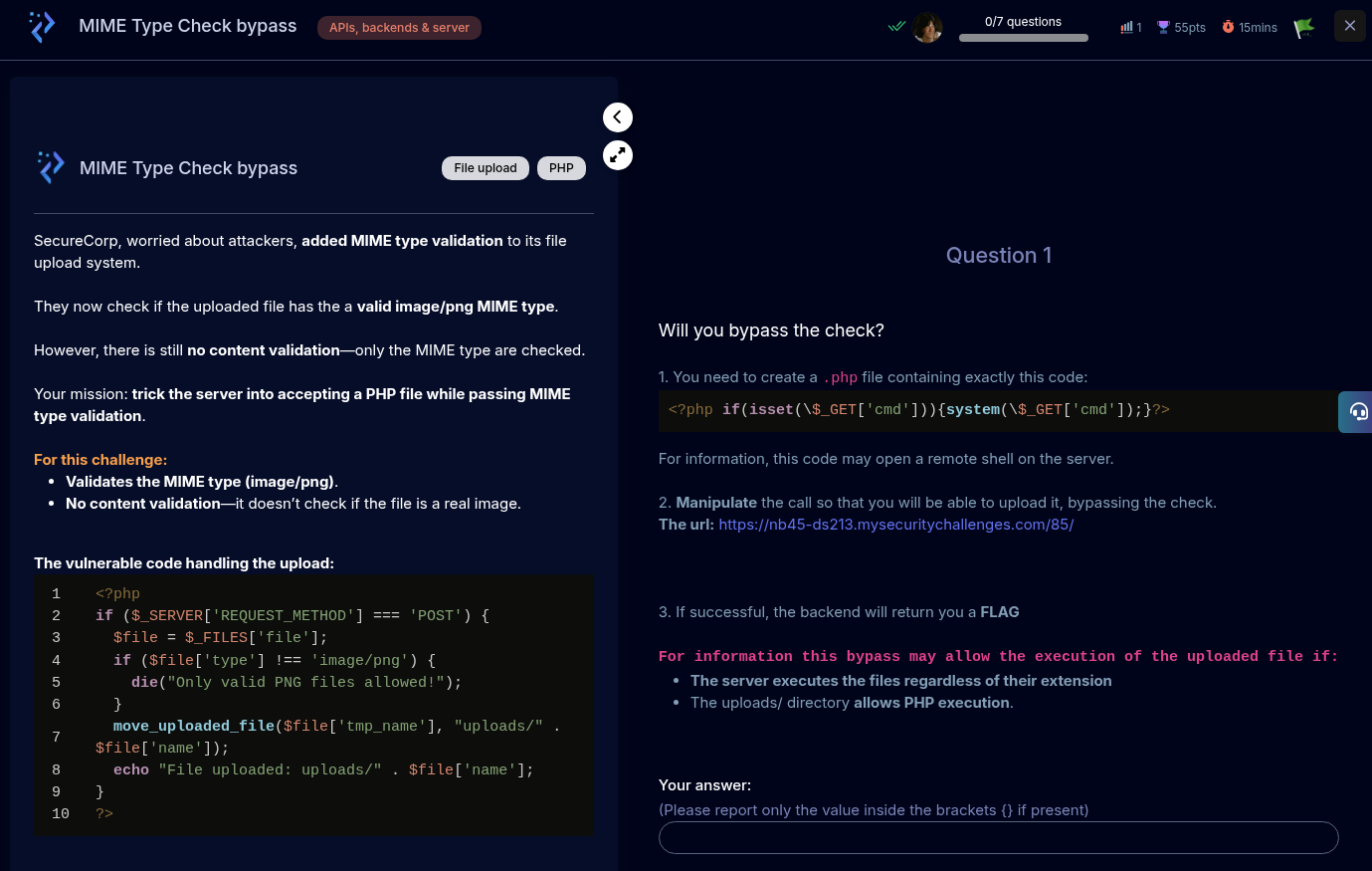
Inside a challenge
The vulnerability is on the left. The exploit is on the right.
Each challenge puts the vulnerable source in front of the learner and walks them through exploiting it — here, a MIME type check that validates the declared type but never the content. They find the bypass, submit the flag, and never write that upload handler again.
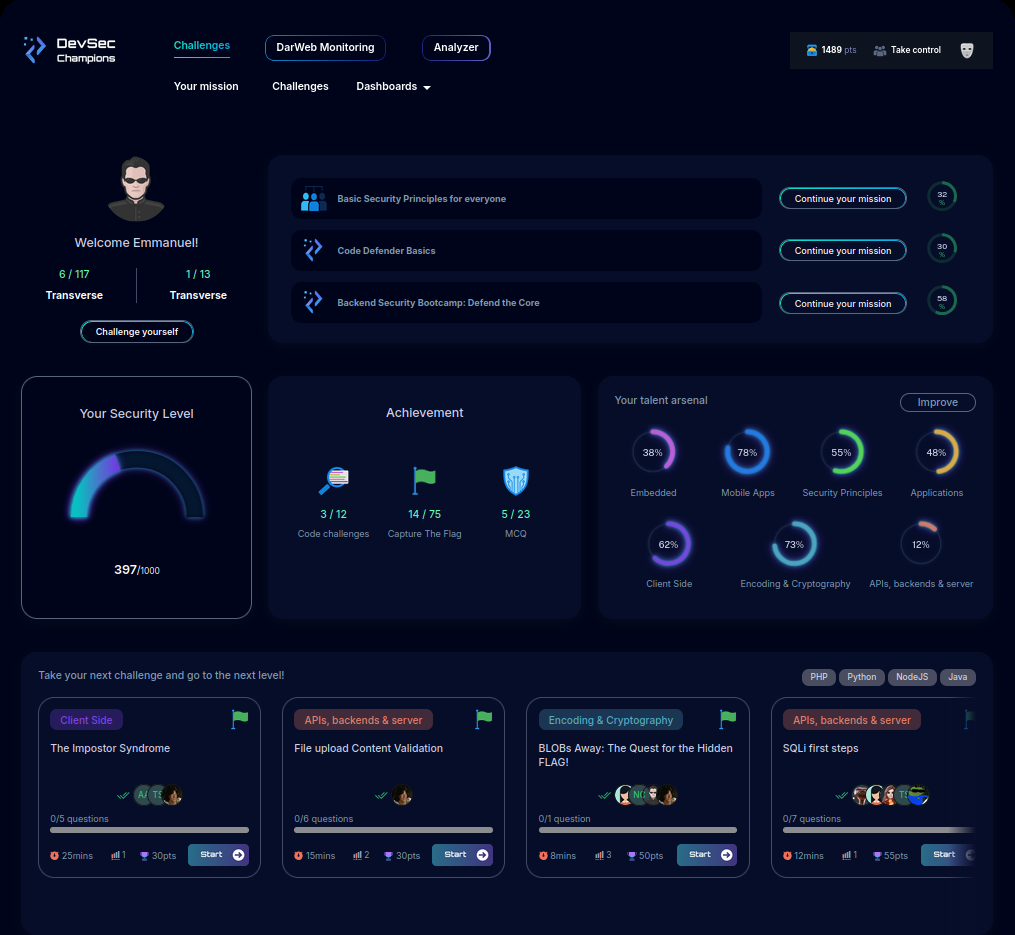
Challenges available across the catalogue
Languages and frameworks covered
Formats: technical labs, Capture the Flag, knowledge checks
Dashboard for the manager who has to report on it
Security training that survives contact with real code.
Real vulnerable code
Hands-on secure coding against code that actually contains the flaw — not a sanitised example.
Think like an attacker
Hands-on challenges that show how vulnerabilities are exploited, making defensive practices easier to understand and apply.
Learning that can be measured
Targeted multiple-choice questions that confirm what was understood, not what was clicked through.
Breadth that matches your stack
More than 100 challenges across 10+ programming languages and frameworks.
Champions, not attendees
Selected developers become the security referent inside their own squad, with the skills to guide secure development.
Evidence for the auditor
Progression, coverage and completion tracked per team — reportable without a manual export.
How a program runs
Standalone or inside an advisory engagement. Either way the sequence is the same.
Assess the team
We map your stack and pick the champions with you — usually one or two per squad, chosen for influence rather than seniority.
Learn by exploiting
The cohort opens on a live exploitation session against code that resembles yours. It sets the tone: this is practice, not theory.
Reinforce through practice
Challenges are released on a rhythm the teams can absorb alongside delivery work, with scoring and team comparison to sustain it.
Measure progress
Skill benchmarking per team, coverage per language, and a management view that answers the question an auditor will ask.
Capabilities and fit.
Reading about a vulnerability rarely changes how developers write code. Exploiting it once usually does.
Key capabilities
- Secure coding through realistic vulnerable applications
- Interactive challenges and technical labs
- Gamification, scoring and team-based comparison
- Progress tracking and skill benchmarking
- Awareness modules for non-technical teams
- Content mapped to OWASP ASVS and your own internal standards
Ideal for
- Reducing application-layer risk
- Improving secure development maturity
- Raising cyber awareness across technical and non-technical teams
- Organisations that need training they can evidence to an auditor
What it replaces
- Annual compliance e-learning nobody remembers
- Generic slide decks bought by the seat
- One-off workshops with no follow-through or measurement
- Security awareness completed because it was mandatory—not because anyone learned something.
Security by design embedded in daily workflows — and training that is finally engaging, measurable and effective.
What clients ask first.
Can we run it without an advisory engagement?
Yes. All three products are available standalone. Most clients start with the platform and add advisory support around the results.
How is the content organised?
Challenges are organised by security topic, technology and expertise—not just by programming language. Teams can learn secure development through technologies such as APIs, mobile, cloud or Salesforce, deepen expertise in languages like Java, Python or Apex, or build broader awareness around subjects such as phishing, GDPR or password security. The catalogue continues to grow with new challenges across all three dimensions.
How much time does it cost a developer?
Challenges are sized in minutes, not days — most sit between eight and thirty minutes. The cadence is set so it absorbs into a sprint rather than displacing one.
Do the labs run against real infrastructure?
Yes. Challenges are exploitable in isolated lab environments, which is what separates them from a quiz. Nothing touches your systems.
Can we map it to our own secure coding standard?
Yes. Content maps to OWASP ASVS out of the box and can be aligned to your internal standard so completion means something in your own terms.
Can we create our own challenges?
Yes. The platform includes a growing catalogue and can also host challenges based on your own technologies, coding standards or internal security incidents.
Training & Awareness
The advisory side of the same problem: champion program design, executive briefings and incident tabletops.
More products built for security teams.
See DevSec Champions in action.
Explore the platform directly, or talk to us about running DevSec Champions across your development teams.